What You Actually Need: Documents &… | Dialysis Travel Japan
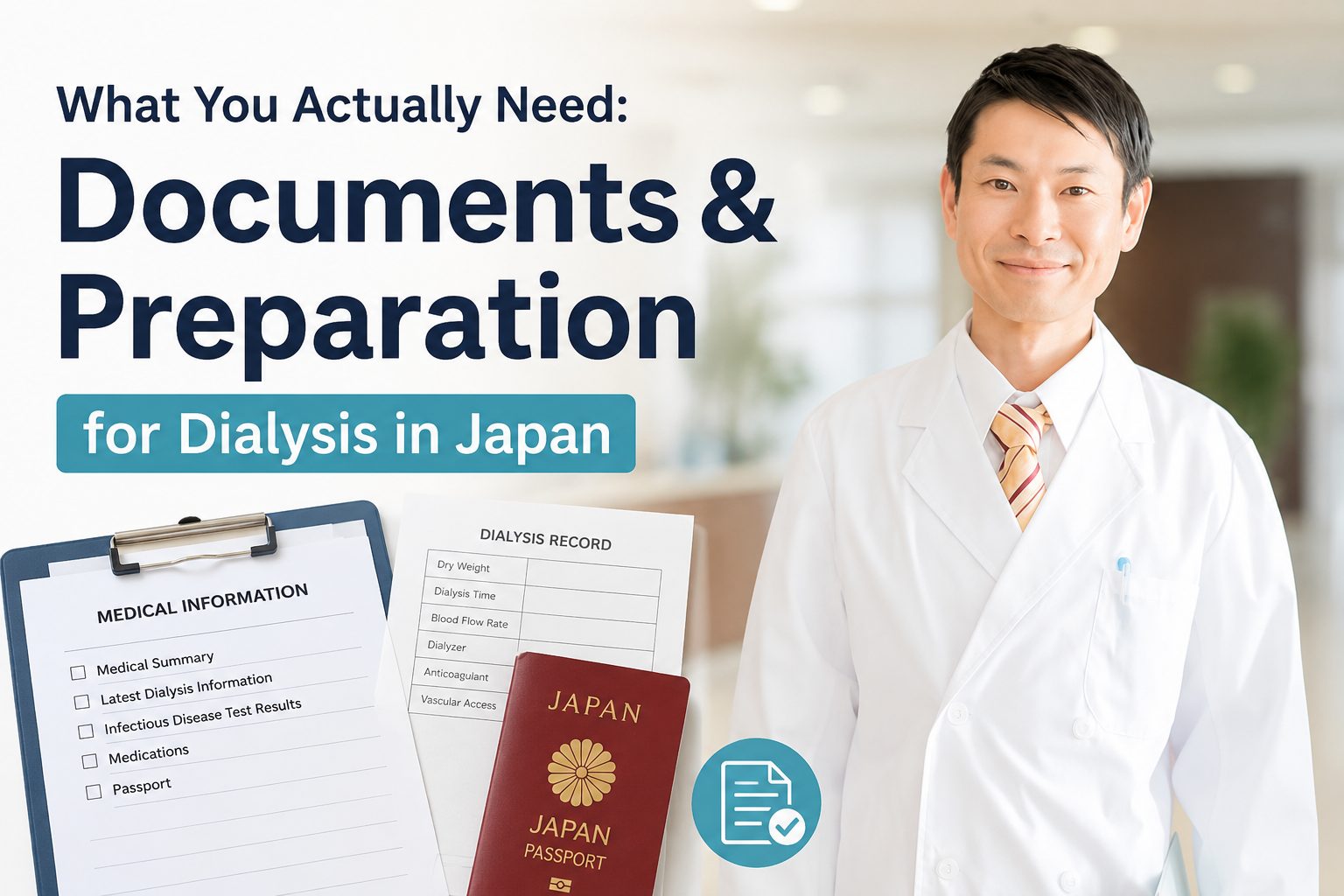
What You Actually Need: Documents & Preparation for Dialysis in Japan
"A referral letter and your last three dialysis records" is the standard advice — and it isn't enough. Here's what a real Japanese clinic submission form actually asks for — dialysate composition, a fistula puncture diagram, infection and TB screening, your nephrologist's signature — and how to prepare in time.
Last updated
"What do I need to bring to get dialysis in Japan?" — it's the question we're asked more than any other.
Most guides answer: a referral letter from your doctor, plus your last three dialysis records. That isn't wrong. But open an actual submission form and you'll see it doesn't come close.
There is no national standard form in Japan. Every clinic has its own. What follows is one real example — the form used by a Japanese clinic that accepts international dialysis travellers. It runs to several pages, it must be completed in English, and it ends with a signature block for your nephrologist.
This is not a referral letter. It is a complete transfer of your dialysis prescription, signed off by the doctor who currently treats you.
We identify the forms and submit them for you.
Which clinic uses which form, what they require, whether they accept English, whether they have a chair free — we handle all of it. Check availability
What the form actually asks for
Patient details and schedule
Name, date of birth, blood type, country of residence, contact details, emergency contact. Your dates in Japan, and the specific dates you want dialysis.
Then something unexpected: the name, phone number and URL of your hotel.
Which means your accommodation has to be booked before you can submit the form. We'll come back to why that's a problem — the clinic hasn't agreed to take you yet, but you've already committed to the hotel.
Laboratory data (within the last 3 months)
Hematocrit, hemoglobin, BUN, creatinine, potassium, alkaline phosphatase, GOT, GPT, and URR (urea reduction rate) — each with the date the test was done.
And a copy of the laboratory report must be enclosed for:
HBs Ag (antigen), HBc Ab (core antibody), HBs Ab
HCV
HIV
Tuberculosis status
Almost nobody warns travellers about the tuberculosis screening.
The infection screening isn't bureaucratic box-ticking. Japan's dialysis infection-control guideline (published by the Japanese Association of Dialysis Physicians) recommends that patients who are HBs antigen positive, HBe antigen positive, or HCV antibody positive be assigned a fixed bed position and, wherever possible, treated in a private room.
In other words, your infection status determines which chair you sit in. Without that data, the clinic physically cannot plan your session.
Your dialysis prescription, in detail
This is the longest part of the form.
Date you started dialysis. Hours per session. Sessions per week. Date of your last session before you arrive. HD or HDF. Type of replacement fluid. The dialyser model and its surface area. Fistula site. Type of vascular access. Type of needle.
Venous pressure range. Hourly water removal rate. Blood flow. And the dialysate composition — Na⁺, K⁺, Ca²⁺, Mg²⁺, bicarbonate, acetate, whether glucose is used, dialysate flow rate, dialysate temperature.
ESAs (epoetin alfa / beta / kappa, darbepoetin alfa, epoetin beta pegol): the agent, the dose, the route (subcutaneous or intravenous), and the date started. Anticoagulant (heparin sodium, dalteparin, nafamostat): initial dose, hourly dose, intermittent dose, and the time it's stopped.
Pre- and post-dialysis blood pressure. Dry weight. Average interdialytic weight gain. Cause of renal failure and comorbidities. ECG, chest X-ray, and CTR (cardiothoracic ratio) — each with the date of examination.
Your medications must be listed with both the active ingredient and the brand name. Brand names differ between countries; without the generic name, a Japanese pharmacist cannot match your prescription. The form also notes that you should bring your own supply of oral medication.
A diagram of your fistula puncture site
There is an outline of two arms on the form. You mark where the needles go. Or you attach a photograph.
This is the moment the paperwork stops feeling abstract. A picture of your arm becomes part of your medical file.
Your doctor's signature
The final block asks for your referring unit's details — physician's name, hospital, phone, address — and then your nephrologist signs a statement authorising you to receive dialysis treatment at the receiving clinic.
This is not a document you collect. It's a document someone writes for you.
By now the point should be clear: only your nephrologist and your home dialysis unit can complete this form. Not you.
And Japanese clinics take it one step further. Most of them expect the documents to come directly from your home unit to them — not from you. The usual sequence is: you tell your home unit which clinic in Japan you're going to, and your home unit prepares and sends the paperwork.
That means your nephrologist and a Japanese clinic will be corresponding with each other — in English, across several pages, with a signature at the end. Your doctor's cooperation, and their administrative staff's time, is a precondition for your trip. Ask early.
One more thing worth knowing. Japanese clinic websites often list documents like a health insurance card, a Specified Disease certificate, or a disability handbook. Of the 17 clinics in our database that publish a document list, 7 include items like these. They are all for people enrolled in Japan's national health insurance — an overseas visitor cannot hold a single one of them. If you see them listed, they don't apply to you. You'll be paying privately, and the relevant paperwork is your travel insurance and a Guarantee of Payment (GOP) instead.
Sending the documents does not mean you have a booking
This is where people get caught out.
Clinics that publish their intake process describe it like this: the documents arrive → the clinic reviews them and then decides whether it can accept you → it comes back with a yes or no and a treatment time. Some state plainly that the reply will take a while. Others state that if the dialysis beds are full, they will turn you down.
So: your doctor completes several pages in English, you repeat your bloods so they fall within three months, you photograph your arm, you book a hotel, you send it all to Japan — and you can still be declined.
And if you are declined, you start the entire process again with the next clinic.
The last obstacle: how you actually send it
Of the 86 clinics in our database that publish how to book:
81 (94%) require a phone call
39 (45%) offer no channel other than the phone
18 (21%) accept email
Four out of five clinics cannot be reached by email from abroad. The phone line is answered in Japanese, during Japanese business hours, on weekdays. From most time zones, there are only a handful of hours in which you could even place the call.
Then there's fax. Plenty of clinics still list fax as the route for medical documents. Almost no dialysis unit outside Japan still has a working fax machine.
Some clinics do provide their forms in English or Chinese. Many operate only in Japanese. Finding out which clinics accept English is therefore the first task — not the last. Do it in the wrong order and you'll assemble a full document set for a clinic that can't read it.
Working backwards from your departure
8 weeks out — ask your nephrologist whether you're fit to travel
6–8 weeks out — shortlist several clinics; check their forms, their language, and their infection-status policy
4–6 weeks out — ask your nephrologist to complete the form; time your bloods, TB screening, ECG and chest X-ray so they still fall within three months on your treatment date
2–4 weeks out — your home unit sends the documents; you wait for a decision. Keep the next clinic warm in case of refusal
1–2 weeks out — confirm your treatment time, check whether originals must be presented on the day, and pack enough medication for the whole trip
Let us carry this for you.
Identifying each clinic's form, shortlisting the ones that accept English, handling the fax, the phone calls and the Japanese-language email, checking infection-status policy, and starting again elsewhere if a clinic is full — we do all of it. All you do is ask your doctor for the paperwork.
Request dialysis arrangement | Clinics by area: Tokyo · Kyoto · Osaka
Frequently asked questions
Aren't my last three dialysis records enough?
Usually not. Real submission forms ask for dialysate composition, dialyser surface area, ESA agent and dose, anticoagulant schedule, a diagram or photograph of your fistula puncture site, and infection and tuberculosis screening from within the last three months — plus your nephrologist's signature.
Why do they need infection and tuberculosis screening?
Japanese dialysis units separate patients by infection status. The national infection-control guideline recommends a fixed bed position — and a private room where possible — for patients who are HBs antigen positive, HBe antigen positive, or HCV antibody positive. Without that data, a clinic cannot plan where to place you.
When should I repeat my blood tests?
Some clinics require results from within the last three months. Count backwards from your treatment dates so nothing expires while you're travelling. ECG and chest X-ray also need to be dated.
Should I book my hotel before the dialysis is confirmed?
Some forms ask for your hotel name and phone number at the point of submission — yet clinics can still turn you down if they're full. Book somewhere with free cancellation.
Can the documents stay in English?
It depends on the clinic. Some provide forms in English or Chinese; many operate only in Japanese. Confirm that a clinic accepts English before you start assembling documents.
Can I buy my medication in Japan?
Submission forms typically instruct you to bring your own supply of oral medication. Pack enough for the entire trip.
If I send the documents, is my booking confirmed?
No. Most clinics review the documents and then decide whether they can accept you. Some warn that the reply will take time. A clinic may decline because it's full, or because of its infection-status policy — so keep more than one option open.
This article is for information only. Whether you are fit to travel, and on what dialysis prescription, is a decision for your nephrologist. Required documents and forms differ between clinics and may change; always confirm the current requirements with the clinic that will treat you.
Yes — you can travel to Japan while on dialysis. This complete guide walks you through what holiday dialysis is, whether you can travel, what care in Japan is like, the documents you'll need, what it costs, and how booking works — all on one page, with full arrangement support.
Yes — travelling to Japan on dialysis is realistic, as long as you have your doctor's approval and arrange your sessions in advance. Here's what makes it manageable, which clinics already welcome travellers, and the first steps to take before you go.
You may already have a detailed referral letter confirming that you receive regular hemodialysis. A Japanese clinic can still ask for more. The reason is simple: a referral introduces you to another doctor, while a dialysis treatment handover tells the receiving team how to continue your treatment safely from the first session.
Overseas travel insurance rarely means cashless dialysis at a Japanese clinic. Here's how a Guarantee of Payment (GOP) and "Pay and Claim" work — and how to confirm payment, documents and language before you travel.