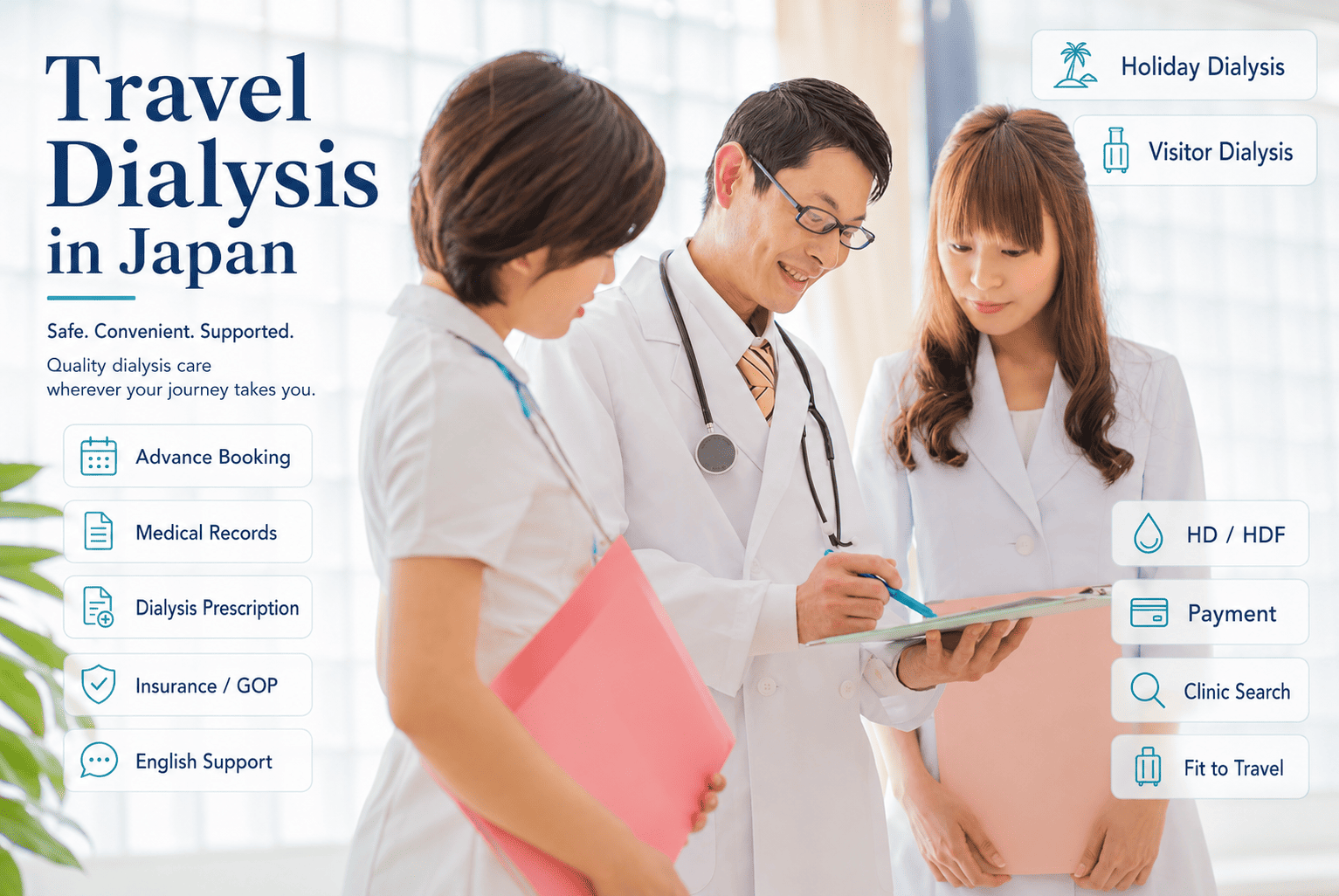
Holiday Dialysis in Japan: The Complete Guide for Travelers
Yes — you can travel to Japan while on dialysis. This complete guide walks you through what holiday dialysis is, whether you can travel, what care in Japan is like, the documents you'll need, what it costs, and how booking works — all on one page, with full arrangement support.
Last updated
If you rely on dialysis, the idea of a trip to Japan can feel out of reach. It doesn't have to be. Travelers on dialysis visit Japan every year and keep to their treatment schedule while they sightsee, see family, or work. The difference between a stressful trip and a smooth one is almost always planning. This guide brings the whole picture together in one place — booking, documents, costs, payment, language, and location — and points you to deeper articles on each. We arrange the logistics so you can focus on your trip; your nephrologist and the treating facility always make the medical decisions.
You don't have to give up your trip to Japan
Needing dialysis does not mean cancelling Japan. With a facility booked ahead of time, your records prepared, and communication arranged, you can arrive on your treatment day already knowing where to go and what to expect.
The single most important habit is to start early. Dialysis slots for visitors are limited, popular travel seasons fill up, and some facilities ask for your paperwork weeks in advance. Give yourself time and the rest becomes manageable.
Let us arrange your dialysis in Japan — one form, every clinic. Free, no-obligation availability check; we handle booking, documents, and interpretation. → Check availability
What "holiday dialysis" means
Holiday dialysis is temporary dialysis you receive while away from your home clinic — on a holiday, a family visit, or a business trip. The treatment itself is the same maintenance dialysis you have at home; only the location changes.
You may see it described in several ways, depending on where you're from:
Transient dialysis (common in North America)
Visitor dialysis or guest dialysis
Travel dialysis / 旅行透析 (in Japan)
洗腎 (for Chinese-language searches)
Whatever the term, the meaning is the same: continuing your regular dialysis at a facility in the country you're visiting.
Can you really travel to Japan on dialysis?
The honest answer is yes — with the right planning. Whether you can travel, and under what conditions, is a medical decision that belongs to your nephrologist and the facility that accepts you. Our role is the coordination around that decision, not the decision itself.
Before you commit to dates, talk with your kidney doctor. They'll typically review your recent lab results, blood-pressure and weight stability, and the condition of your dialysis access to confirm you are stable enough to travel. Travel may be discouraged if you've had recent infection, unstable blood pressure, access problems, or a recent hospital stay. Many care teams suggest having this conversation six to eight weeks before you travel.
Japan is, in many ways, a manageable destination for dialysis travelers: care is high-standard, many facilities offer evening or weekend sessions, and clinics are often close to stations and sightseeing. The catch is capacity — same-day or emergency dialysis is rarely available to visitors, so early arrangement matters.
→ For a fuller look at whether you can travel and what "fit to travel" means, see our detailed explanation.
What dialysis in Japan is like (quality, safety, language)
Japan has a long-established, high-standard dialysis system. Some facilities that accept international patients hold JMIP accreditation (Japan Medical Service Accreditation for International Patients), and many offer not only standard hemodialysis (HD) but also hemodiafiltration (HDF), with strict attention to water quality. For most travelers, the clinical experience will feel familiar.
A few things may differ from home, and it's worth knowing in advance:
Equipment and protocols. Dialyzers, dialysate composition, and anticoagulation practices can differ from what you're used to. Your detailed prescription helps the facility match your care as closely as possible.
Language. This varies a great deal between facilities. Some have multilingual interpretation (English and other languages); others expect you to bring a Japanese-speaking companion. We bridge communication with the facility before and during your visit so a language gap doesn't become a barrier.
Scheduling. Visiting patients are often placed on evening shifts, which can run late. If timing matters for your itinerary, say so early.
What you'll need to prepare (documents and timeline)
Facilities accept you based on your records, so good paperwork is what makes a smooth booking possible. Commonly requested items include:
Your most recent dialysis records (usually the last three sessions)
Your dialysis prescription — session length, frequency, dialyzer type, and anticoagulant
Recent blood test results
Infectious-disease screening results (for example Hepatitis B and C)
A referral letter or medical summary from your physician
A patient information sheet, which the facility usually sends for you to complete and return
Several of these may need translation and must be submitted ahead of time, so begin gathering them as soon as your dates are set. A good rule of thumb: ask your home clinic for these documents at the same conversation where you get your travel clearance.
Three ways to arrange dialysis in Japan — and what each really involves
Travelers usually set up dialysis here in one of three ways. They differ a lot in effort, transparency, and cost, so it helps to know them before you start.
Through a general travel or medical-travel agency. Some agencies arrange dialysis as part of a wider trip package. It's convenient and hands-off, but the treatment is usually folded into one bundled price with the agency's markup on top, and the breakdown is rarely shown. Agencies that don't specialize in dialysis can also be slower to confirm a suitable clinic and less able to answer treatment-specific questions.
Arranging it yourself, directly with clinics. In theory you can contact facilities one by one. In practice it's hard, and for most travelers not realistic. Many clinics publish visitor information only in Japanese, and some ask you to bring a Japanese-speaking companion to your sessions. You would be the one working out which facilities accept overseas patients, translating and sending your dialysis records ahead of time, and coordinating insurance and Guarantee of Payment yourself — often contacting several clinics before one can confirm your dates. A single missed document, or a clinic that turns out to be cash-only, can unravel the plan close to departure.
Through a dedicated dialysis platform — what we do. We focus only on dialysis for visitors. We check availability across facilities for your dates, prepare and submit the documents, arrange interpretation, and coordinate insurance and GOP — then give you one clear, all-in quote. You get the hands-off convenience of an agency without paying for a whole tour you don't need, and without the language and paperwork burden of doing it alone.
How much it costs and how to pay
There usually isn't a single posted price for visitors, and what you pay depends heavily on which of the three routes above you take — along with the clinic, your treatment (HD or HDF), and how much you'd like handled for you — interpretation, transfers, document and insurance coordination, and support on the day. Clinic fees vary from facility to facility, and once the coordination needed to arrange care for an overseas visitor is included, an all-inclusive arranged session typically lands around ¥100,000–¥150,000. Rather than a sticker price, we give you a clear, all-in quote for your dates before you commit.
Two payment points catch travelers out, so plan for both:
Insurance. Dialysis for visitors is generally not covered by Japan's public health insurance if you don't hold a Japanese insurance card, so you usually pay in full, often in advance. Depending on your policy, you may be able to claim the cost back from your own travel or health insurer after you return home — keep every receipt.
Guarantee of Payment (GOP). If you want your insurer to pay the facility directly, the insurer must send a Guarantee of Payment to the facility before your dialysis day. If the GOP doesn't arrive in time, you'll be asked to pay out of pocket on the day and reclaim it later. This is one of the most common surprises, and it's avoidable with early coordination.
On payment methods, confirm in advance: some facilities accept cards, but others are cash-only, and not every facility takes foreign-issued cards. Carrying enough cash as a backup is the safest approach.
Holiday dialysis is not something you can arrange at the last minute. A realistic timeline looks like this:
6–8 weeks ahead (or earlier): get travel clearance from your nephrologist and ask for your records.
3 weeks to 3 months ahead: start arranging the facility. Begin at the earlier end for peak seasons or if you need specific timing, English support, or evening sessions.
Share your location, dates, and dialysis prescription so availability can be checked.
The facility reviews your records and confirms whether it can accept you on your dates.
Submit your documents — often required a week or more before treatment.
Confirm the final details: address, time, and what to bring on the day.
Because same-day and emergency slots are rare for visitors, building in lead time is the best thing you can do for a stress-free trip.
Get an upfront availability check and cost estimate before you book your flights. → Request dialysis arrangement
Let us handle it for you
Contacting facilities one by one, in another language, while you're also planning a trip, is a lot. That's the part we take off your plate. Tell us your destination and dates, and we coordinate the rest:
Checking availability across facilities for your dates
Managing communication and translation with the clinic
Helping prepare and submit your documents
Coordinating payment and GOP so there are no day-of surprises
In most cases, yes — with advance preparation. Many travelers continue dialysis in Japan each year. The key steps are getting travel clearance from your nephrologist and booking an accepting facility weeks to months ahead. Whether travel is advisable, and under what conditions, is decided by your doctor and the treating facility.
How much does a dialysis session cost in Japan?
There's usually no single posted price for visitors — it depends on the clinic, your treatment, and how much support you'd like. Once interpretation, transfers, documents, and insurance coordination are included, an all-inclusive arranged session typically lands around ¥100,000–¥150,000. We give you a clear, all-in quote for your dates rather than a fixed sticker price.
Is dialysis for visitors covered by insurance?
Usually not by Japan's public insurance if you don't hold a Japanese insurance card, so visitors typically pay in full, often in advance. You may be able to claim the cost back from your own travel or health insurance after returning home, so keep all receipts. If you want your insurer to pay the facility directly, a Guarantee of Payment must reach the facility before your dialysis day.
Will the clinic speak English?
It depends on the facility. Some offer multilingual interpretation, while others expect you to bring a Japanese-speaking companion. Because English support is not guaranteed everywhere, we bridge communication with the facility for you, before and during your visit.
How far in advance should I arrange dialysis?
Plan to speak with your nephrologist about 6–8 weeks ahead, and to start arranging the facility 3 weeks to 3 months before your trip — earlier for peak travel seasons. Same-day and emergency dialysis is rarely available to visitors, so arranging well ahead is important.
What documents will I need?
Typically your last three dialysis records, your dialysis prescription, recent lab results, infectious-disease screening, and a referral letter or medical summary from your physician. The facility usually also sends a patient information sheet to complete. Several documents may need translation and advance submission, so gather them early.
Yes — travelling to Japan on dialysis is realistic, as long as you have your doctor's approval and arrange your sessions in advance. Here's what makes it manageable, which clinics already welcome travellers, and the first steps to take before you go.
"A referral letter and your last three dialysis records" is the standard advice — and it isn't enough. Here's what a real Japanese clinic submission form actually asks for — dialysate composition, a fistula puncture diagram, infection and TB screening, your nephrologist's signature — and how to prepare in time.
You may already have a detailed referral letter confirming that you receive regular hemodialysis. A Japanese clinic can still ask for more. The reason is simple: a referral introduces you to another doctor, while a dialysis treatment handover tells the receiving team how to continue your treatment safely from the first session.
Overseas travel insurance rarely means cashless dialysis at a Japanese clinic. Here's how a Guarantee of Payment (GOP) and "Pay and Claim" work — and how to confirm payment, documents and language before you travel.
Holiday Dialysis in Japan: The Comp… | Dialysis Travel Japan