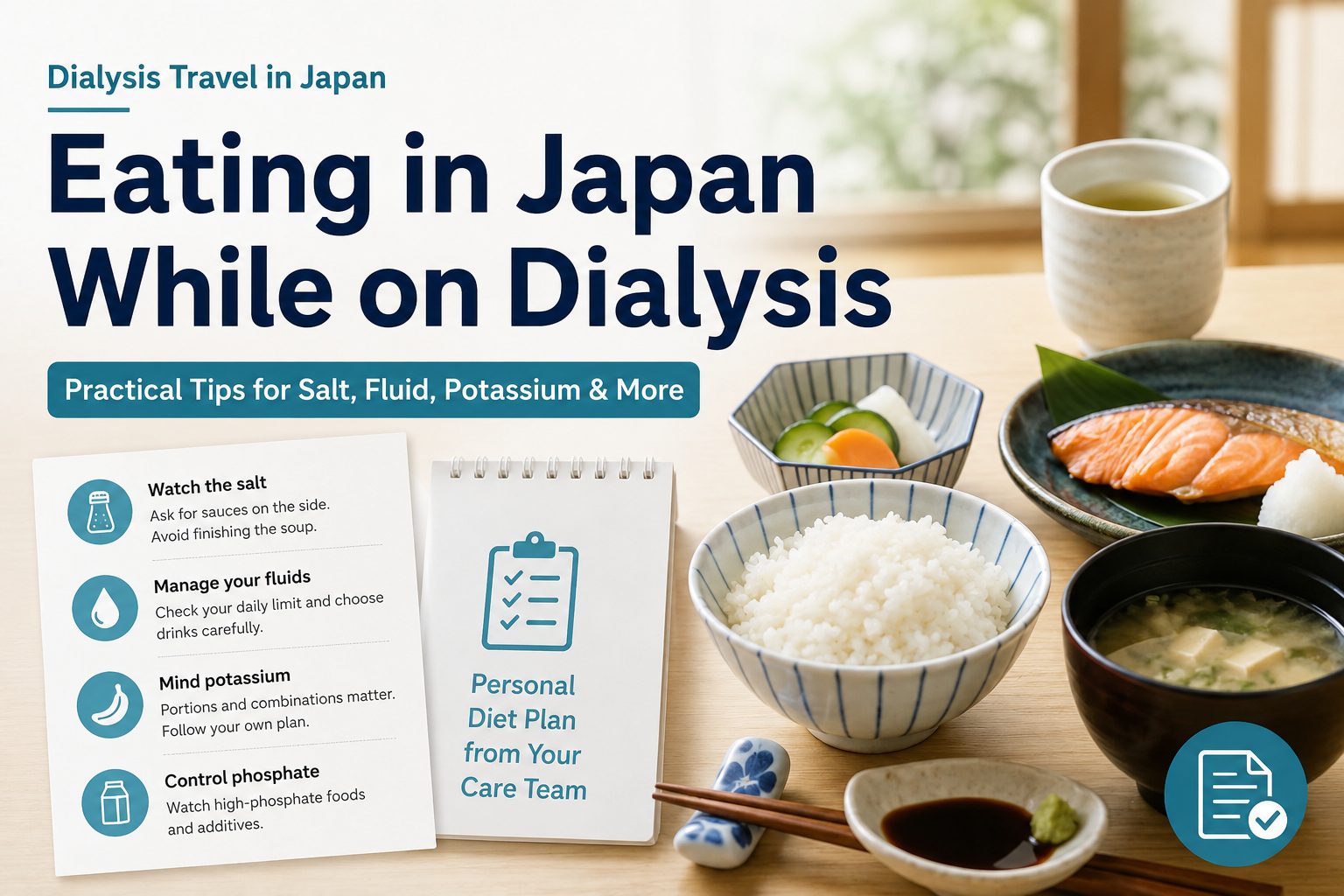
Practical dining tips for hemodialysis travelers managing salt, fluid, potassium, and phosphate in Japan.
Last updated
Japanese food can be one of the highlights of your trip. You do not need a perfect "renal menu" at every meal, but you do need a plan for salt, fluid, potassium, phosphate, and any limits prescribed by your own dialysis team.
Your usual prescription comes first. Dietary restrictions differ according to blood results, residual kidney function, dialysis schedule, medicines, and other health conditions. Continue the plan given by your renal dietitian or nephrologist rather than following a generic food list.
The biggest travel challenge: hidden salt
Soy sauce, miso, noodle broth, pickles, seasoning powders, and prepared sauces can make restaurant meals salty. Salt can increase thirst and make fluid management harder between dialysis sessions.
A useful strategy is to control the parts you can see: ask for sauce separately, use only a small amount, leave soup behind, and avoid combining several salty side dishes in one meal.
Eating in Japan While on Dialysis | Dialysis Travel Japan
Common choice
More manageable approach
Ramen, udon, or soba in broth
Eat the noodles and toppings without finishing the broth. Cold noodles with dipping sauce may make the amount of sauce easier to control.
Sushi with soy sauce
Use a light dab rather than soaking the rice or fish. Some items are already seasoned.
Grilled fish or meat with sauce
Ask whether the sauce can be served separately or whether lighter seasoning is possible. Some restaurants use premade sauces or seasoning that cannot be changed.
Pickles and miso soup as set-meal sides
Leave one or both, or take only a small taste rather than treating every side dish as compulsory.
Convenience-store meal
Compare the label's 食塩相当量 (salt equivalent) per serving and avoid adding extra sauce or dressing.
Potassium: do not use a universal "avoid" list
Some people on dialysis need a strict potassium limit, while others have more flexibility. Portions and combinations matter. Foods that may be relevant include fruit, vegetable juices, potatoes and sweet potatoes, tomatoes, seaweed, beans, chocolate, and concentrated tea powders such as matcha.
Before travel, ask your renal team which foods are most important for you to limit and what portion sizes are acceptable. Be cautious with "low-sodium" salt substitutes, as some use potassium chloride.
Phosphate and processed foods
Processed meats, some cheeses, cola drinks, convenience foods, and products containing phosphate additives may contribute significant phosphate. Japanese labels do not always state the phosphate amount, so follow your normal strategy: limit heavily processed foods, check ingredient lists when possible, and take prescribed phosphate binders exactly as directed with meals.
Fluid still counts when it is food
Soup, noodle broth, ice, jelly, ice cream, and high-water fruit can all contribute to fluid intake. Hot, humid weather and increased walking may affect thirst, but do not change your prescribed allowance by guessing. Discuss a travel-day plan with your dialysis team before departure.
Useful phrases at restaurants
You can say these phrases or show them to restaurant staff on your phone.
健康上、塩分を控えています。 — Kenkōjō, enbun o hikaete imasu. — "I need to limit salt for health reasons." (健康上 = for health reasons; 塩分 = salt content; 控えています = I am limiting)
味付けを薄めにできますか? — Ajitsuke o usume ni dekimasu ka? — "Can you make it lightly seasoned?" (味付け = seasoning; 薄め = lighter)
タレを別にしてください。 — Tare o betsu ni shite kudasai. — "Please serve the sauce separately." (タレ = sauce; 別に = separately)
"Lightly seasoned" is a request, not a guarantee. Restaurants may use premade broth, sauce, or seasoning that cannot be changed. When staff cannot accommodate the request, controlling the portion is often more realistic than expecting a special medical meal.
Reading Japanese labels and menus
These words are useful to recognize on nutrition labels, menus, and product packaging.
Japanese
Pronunciation
English
食塩相当量
Shokuen sōtōryō
Salt equivalent
ナトリウム
Natoriumu
Sodium
カリウム
Kariumu
Potassium
糖質
Tōshitsu
Carbohydrates
塩
Shio
Salt
減塩
Gen-en
Reduced salt / Low sodium
Look first for 食塩相当量 (salt equivalent) when comparing packaged foods. Potassium is not listed on every product, so the label may not provide all the information you need.
A practical way to plan a food day
Choose one main experience. If dinner is a special restaurant meal, keep breakfast and lunch simpler and easier to estimate.
Avoid stacking salty items. For example, noodle broth, pickles, miso soup, and heavily seasoned side dishes in the same meal can add up quickly.
Carry your prescribed medicines. Keep phosphate binders and other meal-related medicines with you, in their original packaging where practical.
Use your dialysis schedule. Plan richer or less predictable meals with advice from your renal team rather than improvising around treatment days.
How Dialysis Travel Japan can help
Dialysis Travel Japan is a matching service that connects international travellers seeking temporary dialysis in Japan with dialysis clinics.
We provide practical travel information, but we do not provide individualized dietary counseling, create meal plans, arrange restaurant requests, manage medical paperwork, or replace advice from a renal dietitian or nephrologist.
Frequently asked questions
Is Japanese food high in salt?
Often, yes. Soy sauce, miso, broths, pickles and many convenience-store items carry far more sodium than they taste like. Soup broth is the single biggest source: leaving most of a ramen or udon broth in the bowl removes a large part of the salt without giving up the meal.
Does miso soup or ramen broth count towards my fluid limit?
Yes. Broth, tea, coffee, sauces and the water in fruit all count. One bowl of ramen broth can be 300-500 ml on its own, which is the most common way travellers overshoot a fluid allowance without realising it.
Can I ask for low-salt food in a Japanese restaurant?
You can ask, and many places will serve sauce on the side, but cooking a dish to order without salt is not usual. It is more reliable to choose food that is naturally lighter — grilled fish, plain rice, sashimi — than to ask for a salty dish to be modified.
Should I follow a standard list of high-potassium foods to avoid?
No. Potassium targets are individual and set by your own renal team, and a generic avoid-list can make a trip far harder than it needs to be. Take your own limits with you and apply them to what is actually on the menu.
Medical disclaimer: This article provides general travel information and is not individualized dietary advice. Follow the targets given by your own renal team. Seek medical advice promptly if you become unwell or are concerned about fluid overload or abnormal potassium levels.
Yes — you can travel to Japan while on dialysis. This complete guide walks you through what holiday dialysis is, whether you can travel, what care in Japan is like, the documents you'll need, what it costs, and how booking works — all on one page, with full arrangement support.
Yes — travelling to Japan on dialysis is realistic, as long as you have your doctor's approval and arrange your sessions in advance. Here's what makes it manageable, which clinics already welcome travellers, and the first steps to take before you go.
"A referral letter and your last three dialysis records" is the standard advice — and it isn't enough. Here's what a real Japanese clinic submission form actually asks for — dialysate composition, a fistula puncture diagram, infection and TB screening, your nephrologist's signature — and how to prepare in time.
You may already have a detailed referral letter confirming that you receive regular hemodialysis. A Japanese clinic can still ask for more. The reason is simple: a referral introduces you to another doctor, while a dialysis treatment handover tells the receiving team how to continue your treatment safely from the first session.