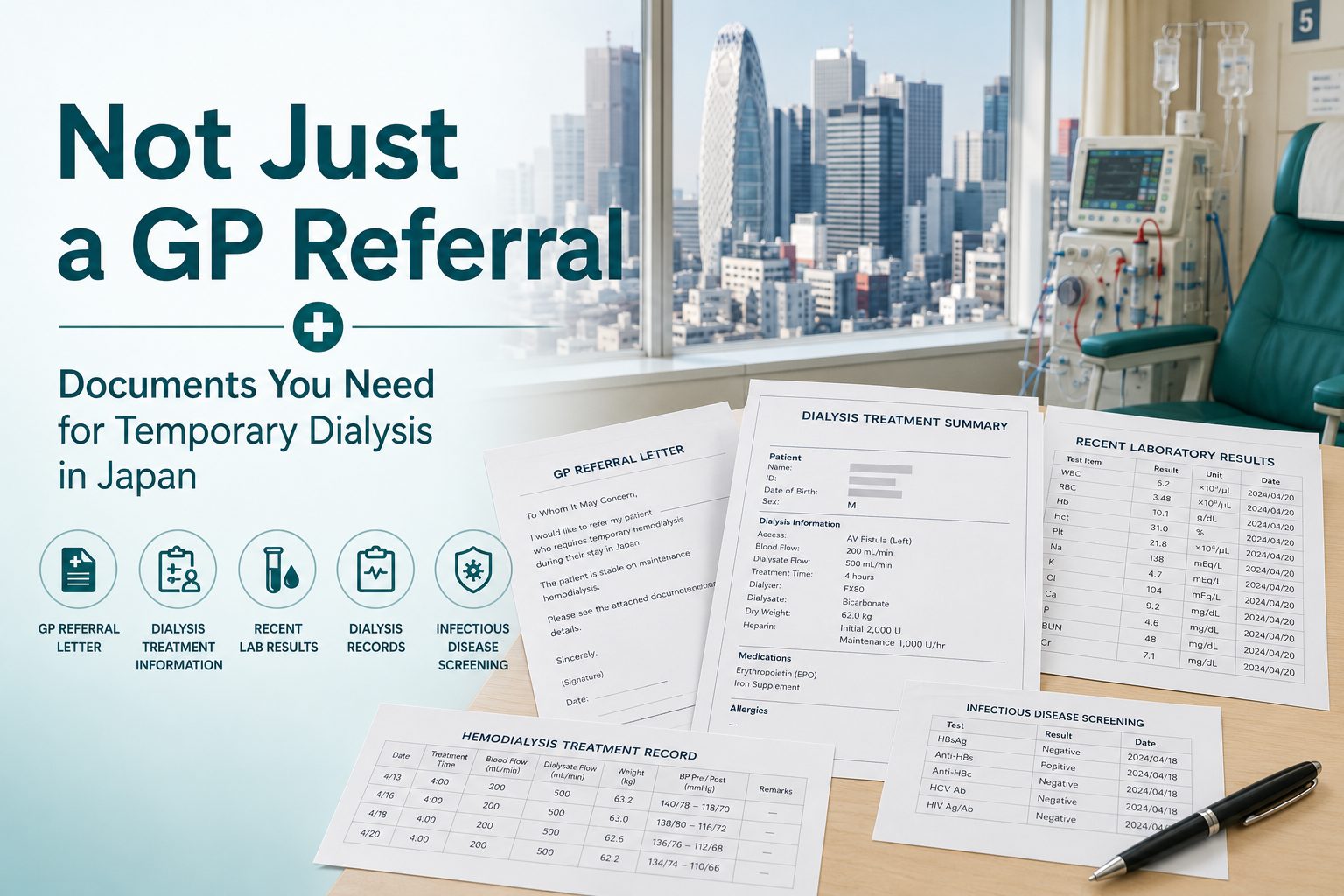
What Documents Do You Need Alongside a GP Referral?
You may already have a detailed referral letter confirming that you receive regular hemodialysis. A Japanese clinic can still ask for more. The reason is simple: a referral introduces you to another doctor, while a dialysis treatment handover tells the receiving team how to continue your treatment safely from the first session.
Last updated
You asked your GP for a referral letter. It includes your diagnosis, medication list and confirmation that you receive hemodialysis three times a week. Yet the Japanese clinic replies with another form—or says that the information is incomplete.
This does not mean your doctor wrote a poor letter. It means the clinic needs a different kind of medical handover.
A standard referral letter is designed to introduce a patient and request assessment or care. Temporary dialysis is different. The receiving clinic is not starting with a consultation and deciding what treatment might be appropriate later. It may need to deliver your next scheduled dialysis session shortly after you arrive.
What Documents Do You Need Alongsid… | Dialysis Travel Japan
To do that safely, the clinic needs recent, specific and actionable information about how your current treatment is delivered.
Dialysis Travel Japan matches international travellers seeking temporary dialysis in Japan with dialysis clinics.Find a facility.
Referral letter vs. dialysis treatment handover
The exact name of the document varies. Your home unit may call it a dialysis prescription, treatment summary, dialysis transfer form, holiday dialysis form or medical information sheet.
The name matters less than the contents.
Feature
Standard referral letter
Dialysis treatment handover
Main purpose
Introduces the patient and requests evaluation or care.
Provides the information needed to continue an existing dialysis plan.
Level of detail
General medical history, diagnosis, symptoms and medication summary.
Treatment duration, blood flow, dialyser details, anticoagulation, dry weight, vascular access and other session-specific information.
Who usually completes it
A GP, PCP or referring physician.
Your nephrologist and regular dialysis unit.
How the clinic uses it
To understand why you need specialist care.
To decide whether it can safely reproduce your usual treatment with its equipment, medication and staffing.
A referral letter introduces you.
A dialysis treatment handover explains how your treatment is currently delivered.
Why Japanese clinics need more than a general summary
In Japan, patients can often visit specialists without first obtaining a GP referral. Inside a dialysis unit, however, the receiving team faces a separate question: can this clinic safely deliver the traveller's established treatment?
The team may need to confirm that its equipment, available dialysers, medication, nursing procedures and infection-control arrangements are compatible with your needs. It must also decide whether any additional precautions, scheduling adjustments or clinical review are necessary.
A sentence such as "the patient receives routine hemodialysis three times a week and is clinically stable" is useful background. It does not tell the clinic enough to prepare an actual session.
In addition to a GP referral letter, you need to submit documents containing detailed information required for dialysis treatment.
What information a clinic may request
Requirements vary by clinic, but a Japanese dialysis facility may ask for information such as:
Vascular access: access type, location, needle size, puncture method and any previous complications. A diagram or photograph may be requested.
Treatment schedule: treatment duration, sessions per week and the date of your last dialysis session before arrival.
Dialyser details: dialyser model, membrane type and surface area.
Machine settings: blood flow rate, dialysate flow rate, dialysate composition and temperature where applicable.
Fluid management: current dry weight, recent pre- and post-dialysis weights, average interdialytic weight gain and ultrafiltration information.
Anticoagulation: anticoagulant type, initial dose, maintenance dose and stop time.
Medication: current medication using both generic and brand names, including ESA treatment where relevant.
Recent treatment records: flowsheets from recent sessions showing blood pressure, weight, fluid removal and treatment observations.
Relevant history: cause of kidney failure, comorbidities, allergies, previous dialysis complications and special precautions.
Requirements are clinic-specific.
Why your regular dialysis unit matters more than your GP
Your GP can provide valuable information about your overall health. However, the most detailed dialysis information usually sits with your regular dialysis unit and nephrologist.
They are the people who know your current prescription, access procedure, usual blood-pressure pattern, fluid-removal limits, anticoagulation schedule and recent treatment history. They may also be asked to sign the receiving clinic's form or send the documents directly.
That is why asking only for "a travel letter" can create delays. A better request is:
"The clinic in Japan requires a completed dialysis treatment form and recent records. Could my nephrologist or dialysis unit help prepare and send them?"
Infection and tuberculosis screening
Another reason a general referral may be returned is that it does not include recent infection-screening results.
Japanese dialysis clinics may request recent results for:
Hepatitis B
Hepatitis C
HIV
Tuberculosis screening
The exact tests and acceptable dates vary by clinic. Some facilities may request a recent chest X-ray report or an IGRA blood test such as QuantiFERON, depending on their screening policy.
This information is used to plan the session safely. Depending on the facility, it may affect bed placement, machine allocation, appointment time or other infection-control arrangements.
These tests may not be included in your routine monthly blood work. Your GP or home unit may therefore leave them out unless you provide the clinic's actual checklist.
How to prepare the right documents
Obtain the receiving clinic's requirements first.
Contact your regular dialysis unit or nephrologist.
Check the age of your tests.
Arrange missing tests early.
Gather dialysis records for the number of sessions specified by the clinic.
Allow time for follow-up questions.
Working backwards from your departure
There is no universal timeline, but starting several weeks before travel gives your doctors and the receiving clinic time to exchange information.
6–8 weeks before departure — Confirm with your nephrologist that travel is appropriate, shortlist clinics and obtain their document requirements.
4–6 weeks before departure — Ask your dialysis unit to complete the clinic form. Arrange any missing blood tests, TB screening, ECG or chest X-ray.
2–4 weeks before departure — Submit the completed medical documents and respond to any additional questions from the clinic.
1–2 weeks before departure — Confirm the approved treatment dates and times, check what originals you must bring and pack enough medication for your trip.
Sending documents does not automatically mean that your booking is confirmed. The clinic must first review your medical information and decide whether it can accept you on the requested dates.
How Dialysis Travel Japan can help
Dialysis Travel Japan is a matching service that connects international travellers seeking temporary dialysis in Japan with dialysis clinics. Find a facility near my hotel.
Frequently asked questions
Is a referral letter from my GP enough to get dialysis in Japan?
Usually not. A Japanese clinic needs your dialysis prescription and recent results from the unit that actually treats you — dry weight, dialyser, anticoagulant, access type and session length. A general practitioner's summary rarely contains those, so request the handover from your dialysis unit rather than your GP.
How recent do my infection test results need to be?
Most clinics ask for HBs antigen, HCV antibody and HIV results from within the last three months, and some add syphilis or tuberculosis screening. Older results are commonly refused, so time the blood draw to your travel dates instead of reusing a panel you already have.
Do my documents need to be translated into Japanese?
It depends on the clinic. We confirm with the receiving clinic exactly what it requires and tell you whether a Japanese translation is needed. Preparing and obtaining the documents themselves stays with you and your own renal team.
How far in advance should I start collecting documents?
Start six to eight weeks before you travel. Requests through this site cannot be sent less than 14 days before the dialysis date, one month ahead is the recommendation, and clinics typically need about two weeks to review a complete set once they have it.
Disclaimer: This article provides general information only and does not constitute medical advice. Document and screening requirements vary by clinic and may change. Your treatment plan and medical documents must be prepared or confirmed by qualified healthcare professionals. Dialysis Travel Japan provides a matching service only and does not provide medical treatment, medical advice, application coordination or payment guarantees.
Yes — you can travel to Japan while on dialysis. This complete guide walks you through what holiday dialysis is, whether you can travel, what care in Japan is like, the documents you'll need, what it costs, and how booking works — all on one page, with full arrangement support.
Yes — travelling to Japan on dialysis is realistic, as long as you have your doctor's approval and arrange your sessions in advance. Here's what makes it manageable, which clinics already welcome travellers, and the first steps to take before you go.
"A referral letter and your last three dialysis records" is the standard advice — and it isn't enough. Here's what a real Japanese clinic submission form actually asks for — dialysate composition, a fistula puncture diagram, infection and TB screening, your nephrologist's signature — and how to prepare in time.
Overseas travel insurance rarely means cashless dialysis at a Japanese clinic. Here's how a Guarantee of Payment (GOP) and "Pay and Claim" work — and how to confirm payment, documents and language before you travel.